

Table of Contents
- Why Office Noise Derails Client Sessions
- How to Reduce Office Noise Before Your First Client Arrives
- Soundproofing an Office for Private Conversations
- Background Noise Reduction for Video Calls
- Client Confidentiality in Shared Workspaces
- Troubleshooting Noise by Source and Measuring What Works
- When to Book a Private Room or Move to a Dedicated Office
- Frequently Asked Questions
Last Updated: October 5, 2026
Why Office Noise Derails Client Sessions
Managing office noise for client sessions is the practice of controlling sound so that confidential conversations stay private and both people can hear each other without strain.
Sound travels through air gaps, shared walls, and ductwork. You cannot fix all three with one purchase.
Below, we’ll show you exactly how to find your noise sources, fix the cheap ones first, and know when it’s time to move to a private room.
Noise problems usually come from three places: air gaps, shared surfaces, and your own microphone. Fix them in that order, cheapest first.
How to Reduce Office Noise Before Your First Client Arrives
Reducing office noise starts with a 20-minute walk-through before anyone else arrives. Listen at the door, at the chair, and at your desk. Mark every sound you can name.
Map Your Noise Sources
Write down each sound and where it comes from. Most fall into four groups:
- Air gaps under doors, around frames, and at ceiling tiles
- Shared surfaces like common walls, floors, and window glass
- Building systems such as HVAC vents, fans, and pipes
Sort them by how often they happen. A once-a-day delivery truck matters less than a hallway that stays busy all morning.
Low-Cost and Temporary Controls
You do not need a renovation to get quiet. Try these first:
- Add a door sweep or draft stopper to close the gap under your door
- Hang a heavy fabric curtain over the door or a shared wall
- Book sessions outside peak hallway hours
These fixes cost little and take an afternoon. They won’t stop a drill, but they handle most day-to-day noise.
For guidance on safe sound levels at work, see Canadian Centre for Occupational Health and Safety guidance on noise.
Soundproofing an Office for Private Conversations
Soundproofing an office for private conversations means blocking sound at its path, not just softening it.
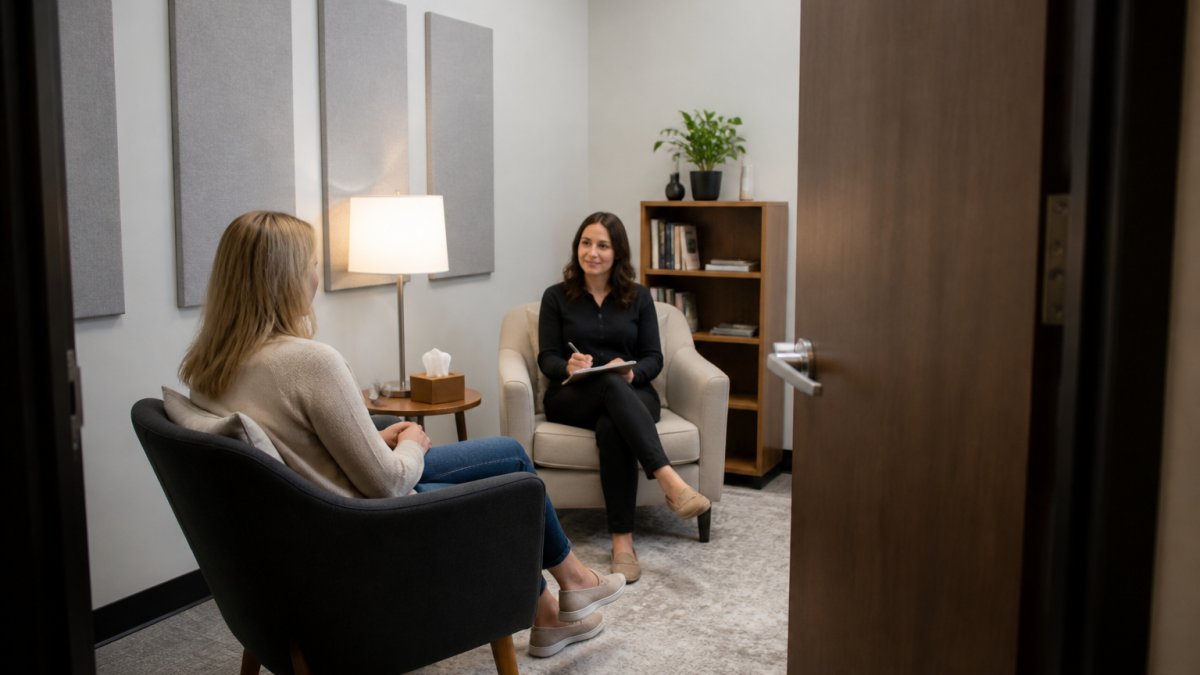
Sound absorption soaks up sound inside a room. It cuts echo and makes speech clearer.
Sound blocking stops sound from passing through. It needs mass and a sealed edge.
Here is the difference in plain terms:
| Control | What it does | Best for | Cost level |
|---|---|---|---|
| Acoustic panels | Absorb echo inside a room | Clearer speech, less reverb | Low to mid |
| Door seals and sweeps | Close air gaps | Hallway and corridor noise | Low |
| Solid core door | Block sound through the door | Private calls and sessions | Mid |
| Double drywall | Add mass to shared walls | Loud neighbors | High |
| Sound masking | Cover speech with soft noise | Open plan and shared areas | Mid |
A common mistake is buying panels to fix a noise problem coming through the wall.
Hanging foam panels on a shared wall will not stop your neighbor’s voice. Absorption and blocking solve different problems. Seal the gaps and add mass first.
Background Noise Reduction for Video Calls
Background noise reduction for video calls comes down to four layers: your microphone, your software settings, your room, and your habits. Fix them in that order, because a good mic in a bad room still transmits the room.
Layer 1: The Microphone
A headset with a boom mic beats a laptop mic because the mic sits two to three centimeters from your mouth.
Look for a headset with a cardioid or unidirectional pickup pattern. Cardioid mics reject sound from behind and the sides, so HVAC hum and keyboard clicks fall away.
Avoid omnidirectional mics in shared space. They hear everything equally, which is the opposite of what you want.
Layer 2: Software Settings
Most video platforms ship with noise suppression you may never have turned on. Check these before you buy hardware:
- Zoom: Settings > Audio > Background noise suppression. Set to Low for a quiet room, Medium or High for a noisy one. High can clip the start of words, so test it.
- Microsoft Teams: Settings > Devices > Noise suppression. Options are Auto, Low, High. Auto usually works, but High helps in open areas.
- Google Meet: Settings > Audio > Noise cancellation. Toggle on.
These filters work by building a model of steady background sound, fans, hum, keyboard, and subtracting it. They are poor at sudden sounds like a door slam or a cough. That is why software is a layer, not a fix.
Layer 3: The Room
Where you sit changes what the mic hears:
- Put a soft surface behind you, a curtain, a bookshelf, an upholstered chair. Bare walls reflect your voice back into the mic and make you sound hollow.
- Sit with your back to the wall, not facing it, so the mic points away from the room’s open side.
- Keep the door closed. An open door doubles the noise paths into the room.
Layer 4: Habits
- Mute when you are not speaking. This is the single cheapest noise control available.
- Ask the client to mute during pauses, especially if they are in a shared space too.
- Pause before you speak. A half-second beat lets the noise gate close and stops clipped first words.
Test your setup by recording a 30-second clip from the client’s perspective, join the meeting from a second device and listen back. You will hear room echo and mic artifacts you cannot hear live.
For a plain-language look at how hearing and speech clarity work, see Health Canada information on noise and hearing.
Client Confidentiality in Shared Workspaces
Client confidentiality in shared workspaces depends on speech privacy, not just quiet. A room can be quiet and still leak every word through a vent.
Speech privacy means nearby people cannot understand what you say. It has two parts: blocking sound from leaving, and covering the sound that does.
Practical steps:
- Use a room with a solid door and sealed edges
- Keep your voice at a normal level, not raised
- Avoid taking calls in open areas or hallways
- Use a white noise machine near the door
If you work with health or personal information, check your duties under the Office of the Privacy Commissioner of Canada.
Troubleshooting Noise by Source and Measuring What Works
Most guides tell you to buy panels. Almost none tell you how to prove the fix worked. This section does both: a source-by-source decision guide, then a simple before-and-after method you can run in an afternoon.
Step 1: Name the Source, Then Find the Path
Sound reaches you by one of three paths: through the air (gaps), through a solid surface (walls, floors, glass), or through the building’s structure (ducts, pipes, framing). The path determines the fix.
| Noise source | Likely path | First fix to try | Why it works |
|---|---|---|---|
| Hallway voices | Air gap under door | Door sweep plus perimeter seal | Closes the leak; gaps pass more speech than the door itself |
| Neighbor’s TV or voice | Shared wall | Bookshelf or added mass on the wall | Mass reduces transmission; absorption alone will not |
| HVAC hum or rumble | Duct and structure | Report to building management; add a vent silencer if allowed | Low-frequency sound travels through ducts and framing |
| Traffic outside | Window glass | Heavy curtain with a sealed edge, or move rooms | Glass is thin; a sealed heavy layer adds mass and a barrier |
| Keyboard and clicks | Open mic | Headset with cardioid mic | Distance and pickup pattern cut the noise at the source |
| Construction or drilling | Structure and air | Move the session, or relocate to an interior room | No affordable treatment stops impact noise through structure |
| Printer, coffee machine | Air and shared surface | Relocate the device, or schedule around it | Removing the source beats treating the symptom |
Work top to bottom. Fix the cheapest, highest-frequency source first. If the noise is intermittent, a delivery, a weekly meeting, scheduling around it is often cheaper and more effective than any treatment.
Step 2: Measure Before and After
You do not need a lab. You need a repeatable reading and a consistent condition.
What to measure:
- Ambient level, the room’s background sound with no one talking. A free sound-meter app on your phone is enough for a rough reading.
- Speech intelligibility, can you understand words from the hallway or the next room? This matters more than the number. A room can be quiet and still leak every word.
How to run the test:
- Pick a busy hour, mid-morning or right after lunch, and note the time.
- Stand or sit where the client sits. Take a 30-second ambient reading with the app.
- Have a colleague speak at normal volume from the hallway or next room. Note whether you can make out words.
- Apply one fix. Wait a day so conditions are similar.
- Repeat the same test at the same hour. Compare the reading and the word test.
What good looks like:
- The ambient reading drops noticeably, and you can no longer understand words from outside the room.
- If the reading drops but you can still hear words, the problem is a gap or a path you have not sealed. Absorption reduced echo, not transmission.
- If neither changes, the path is structural, through the wall, floor, or duct, and needs mass or a different room.
Change one thing at a time. If you seal the door and hang panels on the same day, you will never know which one solved the problem, and you will overspend on the next fix.
Step 3: Decide Whether to Treat or Move
If two rounds of fixes do not pass the word test, the building is the limit. At that point, a private room or a dedicated office is cheaper than chasing diminishing returns with treatments. Test any room you are considering during a busy hour, not on a quiet tour.
When to Book a Private Room or Move to a Dedicated Office
Booking a private room makes sense when your fixes stop working.
Signs it’s time to move:
- Clients comment on noise or seem distracted
- You raise your voice to be heard
- You avoid certain topics because walls are thin
- Back-to-back sessions leave no time to reset the room
A dedicated office solves the root problem. It gives you a sealed space, control over your schedule, and a professional setting clients notice.
At Boss Business Centres, our private offices and counselling rooms sit in a Class “A” building with a high-powered HVAC system, so sessions stay quiet and comfortable.
If you’re weighing a move, book a tour and test the room during a busy hour. That tells you more than any brochure.
Frequently Asked Questions
How can I reduce office noise during client sessions?
Start by identifying where the noise comes from: hallway traffic, HVAC vents, nearby meeting rooms, or street-facing windows. Close your door and seal the gap underneath with a draft stopper, add soft furnishings like rugs and fabric chairs to absorb sound, and book a private room for sessions that involve sensitive disclosures. If you share a wall, position your seating away from it and use a white noise machine or sound masking to cover speech.
Can acoustic panels help with office noise?
Yes, but they do different jobs depending on type. Absorption panels reduce echo and reverberation inside your room, which improves speech clarity on calls. Blocking materials, such as mass-loaded vinyl or solid-core doors, stop sound from traveling between rooms. For client sessions, a combination works best: panels on shared walls to cut reflection, plus door sealing and a solid barrier to limit sound leakage into hallways.
How do I protect client confidentiality in a shared workspace?
Treat sound as part of confidentiality. Use a private room with a solid door for any session involving personal or health information, keep voices at a conversational level, and avoid discussing identifying details in common areas or elevators. Position your desk away from shared walls, run a sound masking source near the door, and schedule sensitive calls when neighboring offices are quieter. If your building cannot guarantee speech privacy, a dedicated office or counselling room is the safer choice.
When should I book a private room for a client session?
Book a private room any time the session involves confidential disclosures, emotional conversations, or video calls where background noise would distract the client. As a rule, if you would not want the conversation overheard in a café, it belongs behind a closed door. For shorter check-ins or administrative calls, a quiet workspace with a headset and noise-cancelling microphone may be enough. Many practitioners book rooms in 90-minute blocks to allow setup and buffer time.
Noise is one of the few things you can’t talk your way out of during a client session. If your current space keeps leaking sound, it’s time to look at a room built for privacy. Boss Business Centres offers private offices, counselling rooms, and flexible plans with no hidden fees, all in a well-managed building steps from transit. Get started with Boss Business Centres and give every client session the quiet it deserves.