

Table of Contents
- Furnished Office Space for Rent: What You Get and Why It Matters
- Full Service vs. Triple Net: Comparing Commercial Lease Types
- The Benefits of Class A Office Space for Your Business Image
- Flexible Office Lease Terms That Grow With You
- Your Office Space Amenities Checklist Before You Sign
- Pricing Factors for Furnished Office Space for Rent
- Frequently Asked Questions
Last Updated: October 4, 2026
Furnished Office Space for Rent: What You Get and Why It Matters
Furnished office space for rent is a commercial workspace that comes complete with desks, seating, storage, and often meeting room access, so a business can move in and start working without buying a single piece of furniture. For solo practitioners and small teams, that turnkey setup removes the largest upfront cost of leaving a home office.
We have watched this shift play out across the Lower Mainland for more than six years. Counsellors, consultants, and start-up founders increasingly want a professional business address without a five-year commitment. Below, we break down what you actually get, how lease types differ, and which questions to ask before you sign anything.
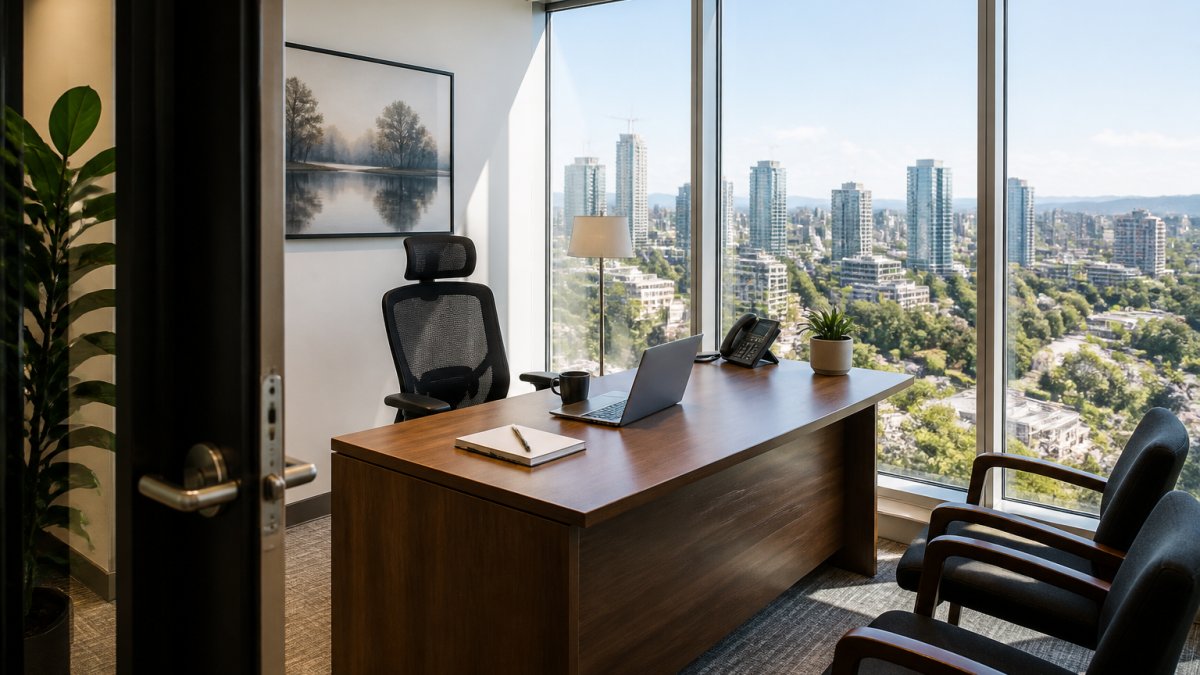
A furnished suite typically includes:
- A desk, ergonomic chair, and guest seating
- High-speed internet and utilities included in one monthly figure
- Shared meeting rooms and reception services
- Kitchen, washroom, and collaboration areas
- A dedicated parking option and transit access
The biggest mistake we see is treating furniture as the main benefit. It is not. According to Innovation, Science and Economic Development Canada’s small business research, small firms drive the majority of private-sector employment, and most of them cannot absorb a long lease on day one.
Furnished space trades a small monthly premium for zero capital outlay. If your cash is better spent on staff or marketing, that trade almost always wins.
Full Service vs. Triple Net: Comparing Commercial Lease Types
Full service leases bundle rent, utilities, maintenance, and often cleaning into one payment, while triple net leases charge base rent plus your share of property taxes, insurance, and maintenance. That single distinction changes your true monthly cost more than the headline rate does.
In Canadian commercial practice, the extra charges in a triple net lease are usually collected as “additional rent” through a monthly operating cost estimate, then reconciled against actual costs at year end. If the landlord under-estimated, you get a bill. If they over-estimated, you get a credit. That reconciliation is the part most first-time tenants do not see coming, and it is why a triple net rate that looks 15 percent cheaper can end up costing more than a full service rate by month twelve.
| Lease Type | What You Pay | Best For | Main Risk |
|---|---|---|---|
| Full service | One bundled monthly figure covering rent, utilities, maintenance, and often cleaning | Solo practitioners, start-ups, anyone who needs a fixed number | Slightly higher base rate; inclusions must be itemized |
| Triple net | Base rent plus your proportionate share of property taxes, insurance, and common area maintenance | Established firms with bookkeeping capacity and predictable occupancy | Year-end reconciliation can produce a surprise invoice |
| Gross with cap | Bundled, with a ceiling on how much operating costs can rise annually | Teams wanting predictability without a full service premium | Caps vary by landlord and often exclude taxes or utilities |
| Modified gross | Base rent plus a defined subset of costs, negotiated line by line | Tenants who want to control specific cost categories | Ambiguous boundaries invite disputes |
A few mechanics worth knowing before you compare quotes:
- Proportionate share. In a multi-tenant building, your share of common costs is usually calculated by rentable square footage. Ask what your percentage is and whether it is fixed for the term.
- Base year vs. base stop. Some leases set a base year of operating costs and only charge you for increases above it. Others set a dollar stop. The difference matters in a building with rising property taxes.
- HVAC hours. Standard hours are typically weekday business hours. After-hours heating or cooling is often billed hourly on top of base rent, even in a full service lease.
- Utilities metering. If utilities are included, ask whether they are metered to your suite or allocated by square footage. Allocation means your neighbor’s server room affects your bill.
Before signing anything, ask for a written list of what is excluded. A common mistake is assuming “full service” covers after-hours HVAC, extra cleaning, or after-hours security escort. It often does not.
If a landlord will not put the inclusions and the reconciliation method in writing, treat the quoted rate as incomplete. Surprise additional rent invoices are the most frequent complaint we hear from businesses that signed elsewhere.
For a small operator, full service is usually the safer choice. You know your number on the first of every month, and you can forecast a year of cash flow on a single line. Triple net rewards tenants who have the admin capacity to track and challenge operating cost statements, and who plan to stay long enough to benefit from a lower base rate.
The Benefits of Class A Office Space for Your Business Image
Class A office space is a building category defined by prime location, high-quality finishes, modern systems, and professional management, and it changes how clients read your business before you say a word. For independent consultants and mental health practitioners, that first impression carries real weight.
The benefits of class A office space come down to three things:
- Credibility. A recognized business address signals stability to referral partners and new clients.
- Client comfort. Floor-to-ceiling windows, reliable heating and cooling, and clean common areas make sessions and meetings easier.
- Recruitment. When you hire, a well-kept professional environment helps you compete for good people.
We operate out of a Class “A” building in Burnaby with a high-powered HVAC system, which matters more than most tenants expect. Quiet, consistent air handling keeps counselling rooms and meeting spaces usable year-round.
Flexible Office Lease Terms That Grow With You
Flexible office lease terms let you scale up or down without renegotiating a long contract, which is the single most useful protection a growing business can build in. Month-to-month agreements, short-term rentals, and expansion clauses all fall under this umbrella.
The question we hear most is simple: what happens if the practice does not grow as fast as hoped? The answer should be that you downsize without penalty. Look for terms that allow:
- A rolling monthly renewal after an initial short term
- A defined expansion path if you add staff
- Clear notice periods, usually 30 to 60 days
- No hidden fees for utilities, parking, or maintenance
A sublease is another route, though it adds a middle party and usually less flexibility.
Your Office Space Amenities Checklist Before You Sign
An office space amenities checklist turns a vague tour into a structured comparison, and it is the fastest way to spot a space that will frustrate you in month three. Walk through it on site, not from a brochure.
- High-speed internet with a stated backup connection
- Meeting rooms you can book without extra charges
- Reception services for client arrivals
- Utilities included and itemized in writing
- Dedicated parking and transit proximity
- Noise levels during peak hours, tested in person
- Washroom and kitchen standards
- Security and after-hours access
- Occupancy limits for your expected team size
Visit at the time of day you will actually work. A space that feels calm at 10 a.m. can be unusable at 4 p.m.
Book a viewing during your busiest client hours, then stand in the exact room you would rent and stay silent for two minutes. You will hear the building’s real noise profile, not the one described on the tour.
Pricing Factors for Furnished Office Space for Rent
Pricing for furnished office space depends on size, lease length, inclusions, and location, so no honest operator quotes a single number before understanding your needs. Square footage, occupancy, and whether you need a private office or a shared workstation all move the figure.
The factors that matter most:
- Size and occupancy. A two-person private office costs more than a single workstation. A three-person office with a meeting table costs more again.
- Lease term. Longer commitments usually lower the monthly rate. A twelve-month term is often priced below a rolling month-to-month plan because the landlord carries less vacancy risk.
- Inclusions. Utilities, internet, parking, reception services, and meeting room hours change the total. Two quotes at the same headline rate can differ by hundreds of dollars a month once inclusions are compared side by side.
- Building class and location. Transit-oriented space commands more. A suite connected to rapid transit typically prices above an equivalent suite that requires a car commute.
- Furnishing level. Executive-quality fit-outs, height-adjustable desks, and ergonomic seating cost more than basic setups.
- Term flexibility. Expansion rights, downsizing rights, and early termination options are priced into the rate. A lease that lets you shrink without penalty is worth more than one that locks your square footage.
How to build your true monthly cost
Rather than comparing headline rates, build a single number for each option you are considering:
- Base monthly rent for your required occupancy.
- Add any separately billed items: parking stalls, storage, additional meeting room hours, after-hours HVAC.
- Add one-time costs: security deposit, setup or signage fees, and any connection or move-in charges.
- Divide one-time costs by the number of months in your term and add that to the monthly figure.
- Compare the resulting all-in monthly number across options, not the advertised rate.
This is the only comparison that reflects what will actually leave your account each month.
The tax angle most guides skip
Furnished versus unfurnished space is treated differently at tax time, and the difference is worth understanding before you sign. When furniture and services are bundled into a single rental payment, you generally have one deductible operating expense and no capital assets to track, depreciate, or dispose of. When you furnish the space yourself, you are typically purchasing capital assets, which may be depreciated over time under the rules that apply to your business structure, and you carry the resale, repair, and replacement risk on those assets.
For a solo practitioner or a small team, the bundled approach usually means simpler bookkeeping and no capital tied up in furniture that may not fit your next space. For a larger firm with predictable long-term occupancy, owning the fit-out can make sense because the assets remain on your books and can be used across locations. The right answer depends on your structure, your expected tenure, and how your accountant treats leasehold improvements versus furniture and equipment.
Speak with an accountant about how these rules apply to your business before you decide. The monthly rate is only one input into the decision.
Ask every landlord for a written inclusions schedule and a sample invoice before you compare quotes. If two options look identical on price, the one with the clearer inclusions schedule is almost always the cheaper choice over a full term.
We keep our plans free of hidden fees, and we will walk you through exactly what is included before you commit. Contact us for current availability and a quote built around your team size.
Frequently Asked Questions
What are the primary advantages of renting a furnished office space?
A furnished office space for rent eliminates upfront furniture costs, setup time, and design decisions. You get desks, chairs, storage, and often meeting room access from day one. For solo practitioners or small teams, this means you can start seeing clients or hosting meetings immediately without ordering and assembling furniture. Furnished offices also simplify relocation: if you outgrow the space, you move without moving assets.
Does a furnished office lease typically include utilities and internet?
In most serviced office arrangements, utilities and high-speed internet are bundled into one monthly fee. That covers heat, electricity, and shared building systems, plus business-grade internet. Confirm what is included before signing: some providers charge separately for parking, extra meeting room hours, or printing. Ask for a written list of inclusions so there are no surprises on your first invoice.
What is the difference between a private office and a virtual office service?
A private office is a dedicated, lockable workspace you use daily for focused work or client sessions. A virtual office gives you a professional business address and mail handling without a physical desk. Many growing businesses start with a virtual office to establish credibility, then upgrade to a private office when they need a consistent place to meet clients or house a small team.
Are short-term leases available for furnished office suites?
Yes. Flexible office lease terms, including month-to-month agreements and short-term rentals, are common for furnished suites. This suits startups, consultants, and remote-first companies that need to scale up or down without a long commitment. Ask about notice periods and any fees for changing office size, so you understand exactly how much flexibility you have before you commit.