

Table of Contents
- Quick Comparison: Flexible Desk Space Options for Freelancers
- How We Evaluated These Workspace Providers
- 1. Boss Business Centres: Best for Local, Family-Owned Professional Space
- 2. Industrious: Best for Premium Hospitality-Driven Workspaces
- 3. Venture X: Best for Community-Focused Coworking
- 4. Upflex: Best for Freelancers Who Travel Frequently
- 5. DropDesk: Best for On-Demand Desk Booking
- 6. Lucid Private Offices: Best for Privacy-Focused Freelancers
- Frequently Asked Questions
Last Updated: September 25, 2026
Quick Comparison: Flexible Desk Space Options for Freelancers
A flexible desk space is a workspace you rent on short or rolling terms rather than a multi-year commercial lease, letting you scale up or walk away as your workload changes. For freelancers, that flexibility matters more than square footage. Boss Business Centres has spent years watching independent professionals cycle through bad fits, and the pattern is consistent: the wrong desk costs you focus, not just money.
| Provider | Best For | Setup | Commitment |
|---|---|---|---|
| Boss Business Centres | Local, family-owned professional space | Private offices, counselling rooms, virtual office | Flexible plans, no hidden fees |
| Industrious | Premium hospitality-driven workspaces | Private offices and shared workspace | Subscription |
| Venture X | Community-focused coworking | Hot desks, dedicated desks, meeting rooms | Membership tiers |
| Upflex | Freelancers who travel frequently | Aggregated network access | Single membership |
| DropDesk | On-demand desk booking | Short-term shared desks | Flexible plans |
| Lucid Private Offices | Privacy-focused freelancers | Private suites | Flexible lease terms |
How We Evaluated These Workspace Providers
Most workspace roundups rank providers on vibe. That is useless when you are signing a contract that could follow you for twelve months. We scored each provider on five weighted criteria, and we explain the weighting so you can re-run the same test on any space we did not cover.
The five criteria and how they are weighted
| Criterion | Weight | What we actually checked |
|---|---|---|
| Cost transparency | 30% | Is pricing published? Are there setup fees, deposit terms, or per-use charges for printing, meeting rooms, and guest passes? |
| Contract flexibility | 25% | Minimum term, notice period to exit, ability to downsize or upsize mid-term, and whether you can pause rather than cancel |
| Quiet and privacy | 20% | Phone-booth availability, whether walls reach the ceiling, sound transfer between rooms, and whether client meetings can be held without walking through an open floor |
| Transit access | 15% | Walk time from the nearest rapid transit stop, plus whether parking or bike storage is included or billed separately |
| Scalability | 10% | What happens when you hire your first contractor or subcontractor, can you add a desk, a second office, or a meeting room credit without renegotiating? |
Pricing carries the most weight because hidden fees are the most common complaint among independent professionals. A headline rate of one figure per month can become a materially higher effective rate once you add a deposit, a setup fee, and per-hour meeting room charges.
The questions to ask before you sign
These are the questions freelancers actually ask us, and they are the ones that separate a good fit from an expensive mistake:
- Can I downsize without penalty? If your biggest client leaves, can you drop from a private office to a dedicated desk, or are you locked in?
- Is it quiet enough for client calls? Ask to sit in the space during peak hours, not at 10 a.m. on a Tuesday when it is empty.
- Is the business address usable on a contract? Some virtual office plans restrict what you can register against the address. Confirm before you commit, because changing your registered address later is a paperwork headache.
- What is the notice period? Thirty days and ninety days are very different commitments when your pipeline is uneven.
A common mistake
Choosing on location alone is the most frequent error. In practice, the contract terms matter more than the postcode, because a rigid lease traps you long after your needs change. A slightly longer commute to a space you can exit in thirty days usually beats a perfect address you cannot leave.
Run the same five-criterion test on any provider, including the ones below. Score each out of five, apply the weights, and compare the totals side by side. It takes ten minutes and it surfaces the trade-offs that marketing pages bury.
What we did not weight
We deliberately left out perks like free snacks, happy hours, and branded swag. They are pleasant, but they do not change whether a space works for your business, and they are the easiest thing for a provider to dress up a weak contract with.
1. Boss Business Centres: Best for Local, Family-Owned Professional Space
Boss Business Centres is a family-owned workspace provider operating for more than six years in a Class “A” building with floor-to-ceiling windows and a direct SkyTrain connection. It offers private offices, counselling rooms, and virtual office services under flexible plans with no hidden fees.

Key Features
- Private offices and dedicated counselling rooms
- Virtual office services with a professional business address
- Class “A” building with a high-powered H-Vac system
- SkyTrain-connected location with nearby services
- Seamless scaling as your team grows
Pros and Cons
Pros: Local, family-owned ownership means you deal with people who know the building. Flexible plans avoid the surprise fees that plague larger chains. The space is well-managed and clean, and tenants report a strong sense of community.
Pricing
Pricing depends on the office type, size, and term. Contact the team directly for current rates and availability rather than relying on a generic figure.
2. Industrious: Best for Premium Hospitality-Driven Workspaces
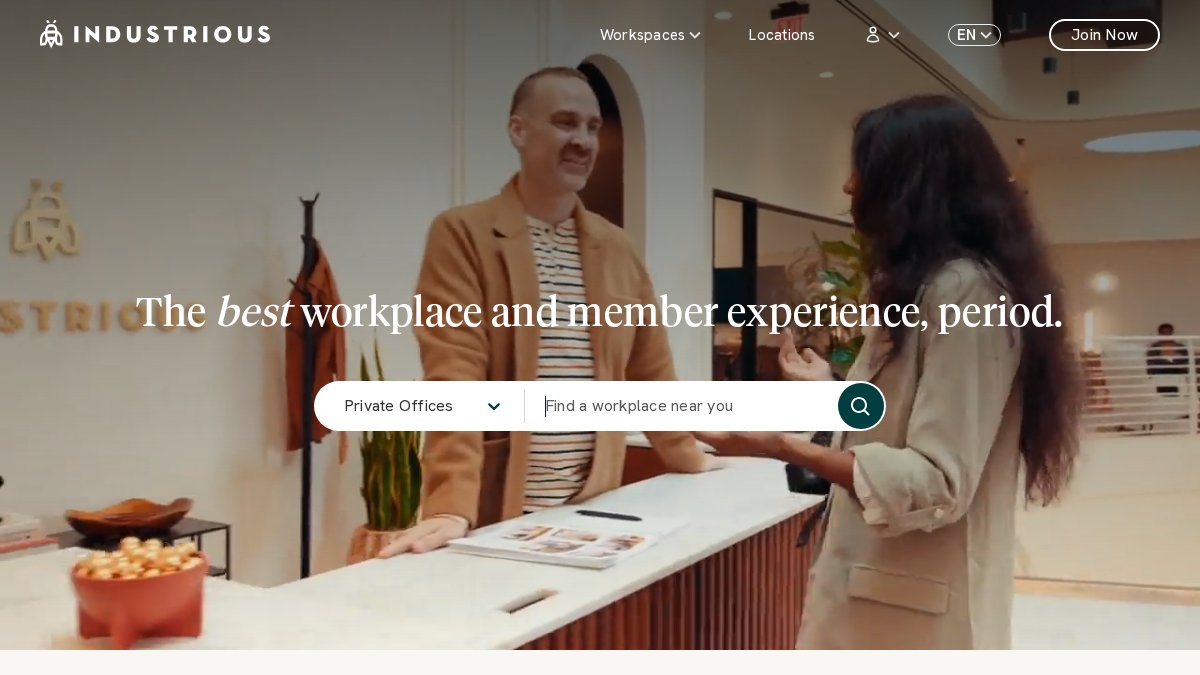
Industrious leans hard into hospitality. Think concierge-style service, high-end interior design, and all-inclusive pricing that folds snacks, coffee, and printing into one fee.
Key Features
- All-inclusive pricing covering snacks, coffee, and printing
- On-site community managers
- Strong focus on private office and shared workspace design
Pros and Cons
Pros: The design quality is genuinely high, and the member experience is a priority rather than an afterthought.
Pricing
Industrious does not publish standard rates. Expect to contact them for a quote, and expect the premium positioning to show up in it.
3. Venture X: Best for Community-Focused Coworking
Venture X blends a professional environment with a networking culture. If your work depends on meeting people, the community programming is the draw.
Key Features
- Flexible membership tiers including hot desks and dedicated desks
- High-tech meeting room facilities
- Regular community events and networking
Pros and Cons
Pros: The environment is modern and collaborative, and membership tiers let you start small.
Pricing
Venture X quotes per location. Contact for pricing.
4. Upflex: Best for Freelancers Who Travel Frequently
Upflex is an aggregator, not a landlord. One membership unlocks a network of workspaces, which suits freelancers who move between cities.
Key Features
- Access to thousands of workspaces globally
- Centralized booking for desks and meeting rooms
- Real-time availability tracking
Pros and Cons
Pros: Unmatched location variety and a single point of management.
Pricing
Upflex uses a subscription model. Contact for pricing.
5. DropDesk: Best for On-Demand Desk Booking
DropDesk connects freelancers with short-term shared desks through a simple booking interface. It is the lightest commitment on this list, and for a freelancer whose week is split between client sites, home, and coffee shops, that lightness is the entire point.
How the on-demand model actually works
Unlike a coworking membership, you are not buying access to one building. You are buying the right to book a desk, by the day or by the block of days, across a network of partner spaces. You open the app, see what is available near you for the hours you need, and reserve it.
Key Features
- On-demand desk booking by the day or half-day
- Integration with workspace management tools
- Flexible membership plans for individuals
- Access across a network of partner locations rather than a single site
Pros and Cons
Pros: The booking interface is easy to use, and short-term access keeps costs tied to actual use. If you travel between client sites, you are not paying for a desk you are not sitting at. There is no long-term contract to unwind if your work pattern changes.
Pricing
On-demand booking is priced per use rather than per month, which is the model’s main advantage and its main risk. The advantage is that a light month costs less than a membership. The risk is that a heavy month costs more, because per-day rates are almost always higher than the effective daily rate inside a monthly plan.
Who should skip it
If you need a fixed address for your business registration, a place to leave equipment, or a guaranteed quiet room for client meetings, on-demand booking is the wrong tool. It is a supplement to a primary workspace, not a replacement for one.
On-demand booking is best treated as a flexible second option: use it for travel weeks and client-site days, and keep a primary desk for the weeks when you need consistency, storage, and a quiet room on demand.
6. Lucid Private Offices: Best for Privacy-Focused Freelancers
Lucid specializes in private suites with professional on-site management. If client confidentiality drives your choice, this is the model to examine.
Key Features
- Secure, private office environments
- On-site management teams
- Flexible lease terms for private suites
Pros and Cons
Pros: Privacy is the core product, and the management is professional.
Pricing
Contact for pricing.
Freelancers rarely regret paying for a workspace. They regret signing a lease that outlasts the need. Before you commit, decide which matters more: a premium experience, a broad travel network, or a local partner who knows your name. If it is the third, Boss Business Centres offers private offices, counselling rooms, and virtual office services in a Class “A” building with SkyTrain access and flexible plans.
Frequently Asked Questions
What is a flexible desk space, and how does it work for freelancers?
A flexible desk space is a workspace you rent on a short-term or membership basis, without a long-term lease. For freelancers, this means you can choose from hot-desking, dedicated desks, private offices, or day passes depending on your needs. You typically pay monthly or per use, and can scale up or down as your work changes. Many providers include amenities like high-speed internet, meeting rooms, and coffee in the membership fee, giving you a professional environment without the overhead costs of a traditional office.
Are flexible desk space expenses tax deductible for freelancers?
If you are self-employed and use a flexible desk space exclusively for business, you can generally deduct the cost as a business expense on your income tax return. This includes coworking memberships, day passes, and virtual office services. Keep detailed receipts and records of how often you use the space for work. For advice specific to your situation, consult a qualified accountant, as rules can vary based on your incorporation status and provincial regulations.
How does a hot desk differ from a dedicated desk in a coworking space?
A hot desk is an unassigned seat you can use on a first-come, first-served basis, often with a day pass or a basic membership. A dedicated desk is your own reserved spot that stays available whenever you need it, often with storage and a monitor. Hot-desking suits freelancers who work sporadically or enjoy variety, while a dedicated desk provides consistency and a sense of ownership. The choice depends on how often you visit and whether you need to leave equipment behind.
What amenities should freelancers look for in a flexible desk space?
Prioritize high-speed internet, ergonomic furniture, quiet zones for calls or focused work, and access to meeting rooms. Other valuable amenities include a professional business address, mail handling, printing, and a community manager who can help with day-to-day needs. If you meet clients, look for a welcoming reception area and private rooms. Also check for 24/7 access, secure entry, and transit accessibility, especially if you commute. These features can make a shared office feel like a true professional home base.