

Table of Contents
- 1. Boss Business Centres: Dedicated Counselling Rooms in a Class A Building
- 2. Persy Booths: Soundproof Pods for Open-Plan Offices
- 3. Strive Workspaces: Flexible, Privacy-Compliant Therapy Office Space for Rent
- 4. Therapy Space: Turn-Key Offices for Licensed Mental Health Professionals
- 5. Expansive: Private Suites with Sound-Dampening and Quiet Zones
- 6. Office Evolution: Quiet Offices and Meeting Rooms for Client Sessions
- 7. AdvantEdge Business Centres: Virtual and Meeting Room Solutions
- 8. Clarity Health & Wellness: Counselling Office Rentals for Wellness Practitioners
- How to Choose the Right Quiet Office Space
- Frequently Asked Questions
Last Updated: September 21, 2026
1. Boss Business Centres: Dedicated Counselling Rooms in a Class A Building
A quiet office space is a dedicated room designed to reduce noise and interruption so that conversation, concentration, and emotional regulation can happen without interference. For mental health practitioners, the room becomes part of the therapeutic environment.
Boss Business Centres offers dedicated counselling rooms inside a Class “A” building with floor-to-ceiling windows, a high-powered HVAC system, and direct SkyTrain access, pairing private rooms with flexible plans and no hidden fees.
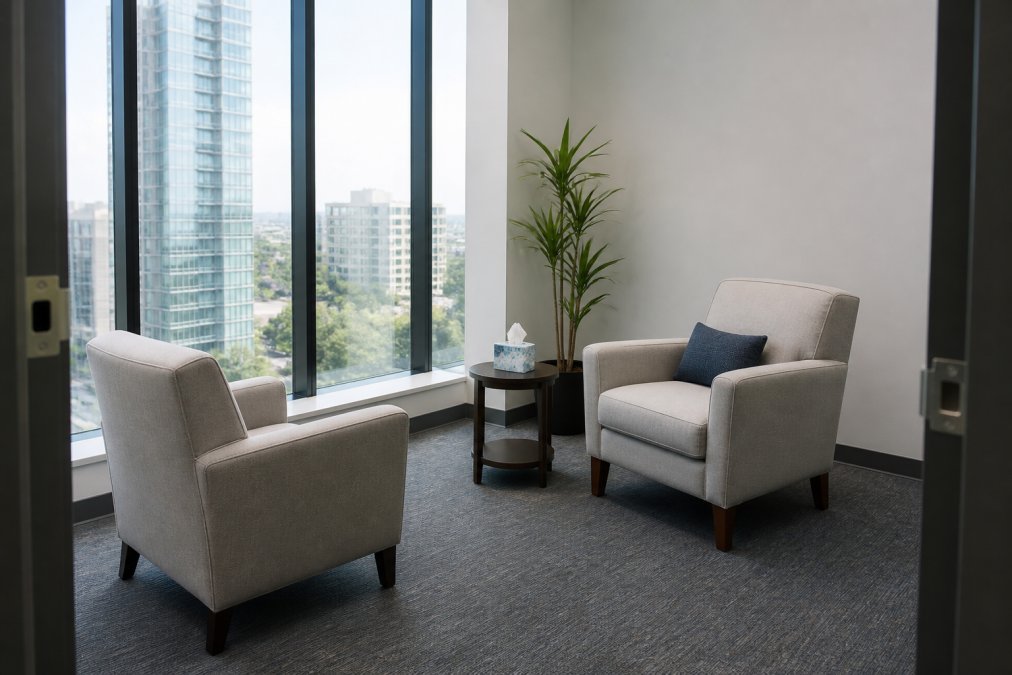
What sets it apart is clinical privacy plus professional infrastructure: windows support alertness, the HVAC system muffles sound transfer, and SkyTrain access removes parking stress.
Privacy, light, and air quality are the three environmental factors practitioners notice first when choosing a room. Boss Business Centres addresses all three in one location.
2. Persy Booths: Soundproof Pods for Open-Plan Offices
Where this approach falls short: pods require physical floor space, and they work best as a supplement to a real quiet room rather than a replacement. If you run back-to-back client sessions all day, a dedicated room still wins.
3. Strive Workspaces: Flexible, Privacy-Compliant Therapy Office Space for Rent
Availability varies by location, so confirm your preferred time slots before planning a client schedule around them. Adherence to privacy regulations is crucial for mental health professionals.
4. Therapy Space: Turn-Key Offices for Licensed Mental Health Professionals
The trade-off is eligibility: access is restricted to licensed professionals, which keeps the environment consistent but rules it out for coaches or unlicensed practitioners.
5. Expansive: Private Suites with Sound-Dampening and Quiet Zones
The mix of private and shared space suits professionals who split their day between client work and collaboration. Shared areas get busy at peak hours, so book critical sessions in your private suite.
Booking a shared quiet zone for a confidential client session is a common mistake. Shared space is not soundproof, and nearby conversations can be overheard. Reserve a private suite for anything involving client disclosure.
6. Office Evolution: Quiet Offices and Meeting Rooms for Client Sessions
Pricing varies by location, so request a current quote rather than assuming rates are consistent across sites.
7. AdvantEdge Business Centres: Virtual and Meeting Room Solutions
Meeting rooms require advance booking, which is a reasonable trade-off for the flexibility the model provides.
8. Clarity Health & Wellness: Counselling Office Rentals for Wellness Practitioners
Inventory is limited compared to large coworking chains, so availability moves quickly.
How to Choose the Right Quiet Office Space
Match the room to how you actually work, not how you imagine you will. The criteria below go past the usual checklist into the mechanisms that determine whether a room holds up under real client sessions.
Start with the acoustic mechanism, not the vibe
A room can look calm and still fail acoustically. What matters is how sound moves through the assembly:
- Wall construction: Ask whether the wall between your room and the next is a demising wall (a full-height partition that runs slab-to-slab) or a partial partition that stops at the ceiling plenum. Partial partitions let conversation bleed over the top even when the wall itself is solid.
- Door sealing: A solid-core door without acoustic gaskets and a drop-down seal leaks sound at the perimeter. The gap under the door is usually the single biggest weak point in an otherwise quiet room.
- HVAC noise: A high-powered HVAC system can mask speech but may also create a low-frequency hum that fatigues clients over a 50-minute session. Sit in the room with it running before you commit.
- Adjacency: A room next to a kitchen, elevator bank, or shared corridor will never be truly quiet, regardless of what is inside the room.
Policy and etiquette: the rules of engagement
Most guides stop at design. What determines whether a quiet space stays quiet is the policy around it, and most providers are silent on this.
- Booking systems: A first-come, first-served quiet room becomes a contested resource. A booking calendar with a 15-minute buffer between sessions prevents one client leaving as another arrives.
- Time limits: Cap continuous use (for example, a two-hour block) so one practitioner cannot occupy the only quiet room for a full day. Enforce it through the booking system rather than through confrontation.
- Noise expectations: State them explicitly. No speakerphone calls in shared quiet zones, headphones required for any audio, and a clear expectation that voices stay at conversational level. Written expectations remove the ambiguity that causes most conflicts.
- Clean-desk and reset rules: A room left with a client’s personal items or a lingering scent from a previous session undermines the next practitioner’s work. A two-minute reset protocol between bookings solves this.
- Signage and signaling: A simple “in session” indicator at the door reduces interruptions without requiring anyone to knock.
Hybrid reality: quiet space for a split workforce
If your team splits time between home and the office, the quiet room serves a different function than pre-2020. Full-time staff use it for deep work and overflow calls, while hybrid staff arrive for meetings and client sessions they cannot run from home, concentrating demand into fewer days and making booking conflicts more likely.
Treat the quiet room as a bookable clinical resource on in-office days and an open focus room on remote-heavy days.
Budget-friendly retrofitting
You do not need a new build to get a usable quiet room. Low-cost interventions, in order of impact per dollar:
- Door sealing kit: Acoustic gaskets and a drop-down seal are inexpensive and address the biggest leak point.
- Area rug and soft furnishings: Absorptive surfaces reduce reverberation, which is what makes a room feel loud even when ambient noise is low.
- Acoustic panels at first-reflection points: Place them where sound bounces off parallel walls, not randomly around the room.
- White-noise or speech-privacy masking: A small masking device near the door raises the background floor just enough to blur speech without being distracting.
- Draft stoppers and plenum baffles: Cheap, and they reduce sound transfer over partial partitions.
Measuring whether it is working
To justify the cost to a partner or landlord, track simple signals rather than anecdote:
- Booking use: What percentage of available quiet-room hours are actually booked? Low use suggests the room is in the wrong place or the wrong size; consistently full use is your strongest argument for a second room.
- Session overruns and interruptions: Count how often sessions run over or are interrupted. A drop after a room change is a concrete result.
- Practitioner retention and satisfaction: A short quarterly check-in on whether people feel they have adequate quiet space is a leading indicator of turnover risk.
- Client feedback: A simple post-session question about whether the space felt private and calm gives you qualitative evidence that supports the business case.
The checklist
- Session volume: Count your weekly client hours. Under 10 hours points to hourly or virtual options; 20+ hours justifies a dedicated room.
- Confidentiality needs: Confirm wall construction and door sealing. Ask whether adjacent rooms share a wall with a high-traffic area.
- Acoustic comfort: Visit at peak hours. A room that is quiet at 9 a.m. may sit beside a busy corridor at noon.
- Policy fit: Ask what booking rules, time limits, and noise expectations apply to the room you are considering.
- Access: Check transit and parking for clients, not just for yourself.
- Contract terms: Ask what happens if your caseload shrinks. Month-to-month terms protect you during a slow quarter.
- Hidden costs: Confirm whether utilities, parking, and maintenance sit inside the quoted rate.
- Growth path: If you plan to hire, ask whether you can expand within the building rather than move.
Visit any space twice: once mid-morning and once mid-afternoon. Noise levels, foot traffic, and natural lighting shift through the day, and a single tour rarely reveals the difference. If you can, sit in the room with the door closed and the HVAC running for a full five minutes before you decide.
For practitioners weighing a home office against a rented room, the deciding factor is usually client perception: a dedicated, professional setting signals protected time and separates work from home.
Frequently Asked Questions
What makes an office space suitable for mental health therapy?
A suitable therapy office needs soundproofing to prevent conversations from being overheard, a private entrance and waiting area, comfortable seating, and a calming atmosphere. It should also comply with privacy regulations. Look for spaces designed for clinical use, such as those offered by Boss Business Centres, which provide dedicated counselling rooms with confidentiality in mind.
How does a quiet environment impact client outcomes in therapy?
A quiet environment reduces distractions and helps clients feel safe to open up. Noise pollution can increase stress and make it harder for clients to focus. When you rent a soundproof office for counselling, you create a consistent, calm setting that supports emotional processing and strengthens the therapeutic relationship.
What are the legal requirements for soundproofing in a therapy office?
Privacy laws require that personal health information not be overheard. While there is no specific decibel standard, therapists must take reasonable steps to ensure confidentiality. Using a soundproof office for counselling or a space with sound masking helps meet these obligations and protects client trust.
Can shared office spaces provide enough privacy for mental health sessions?
Yes, if the shared space is designed with confidentiality in mind. Look for dedicated counselling rooms with acoustic treatments, white noise machines, and private entrances. Many shared office providers, like Boss Business Centres, offer therapy office space for rent that meets these needs, ensuring client sessions remain private even in a shared building.
What amenities should a mental health professional look for in a rental office?
Prioritize soundproofing, a private waiting area, comfortable seating, and flexible lease terms. Also check for reliable internet for telehealth, secure access, and a professional atmosphere. Boss Business Centres offers Class A building amenities, including high-powered HVAC and floor-to-ceiling windows, which contribute to a welcoming, quiet office space for mental health.